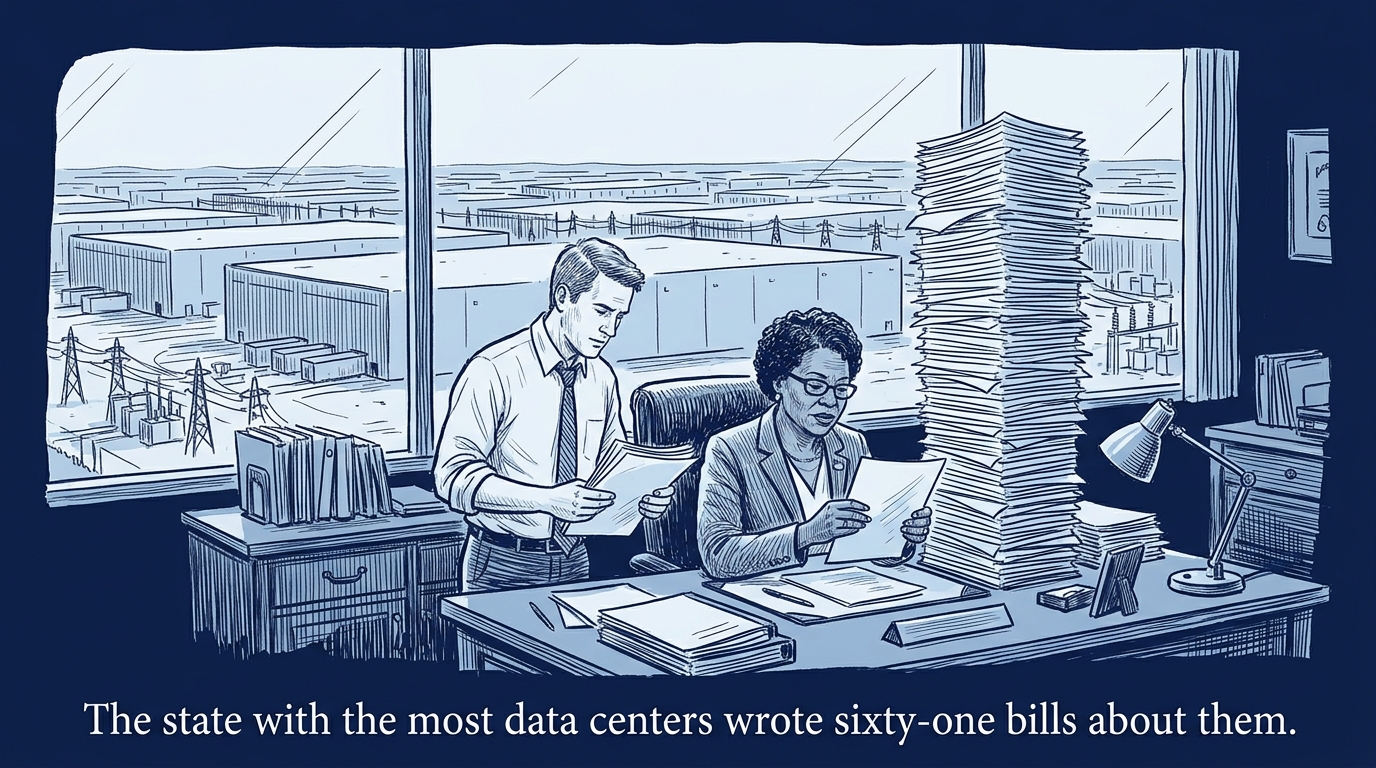
Loudoun County, Virginia is "Data Center Alley" — the highest concentration of data centers on the planet, built there over three decades because Northern Virginia happened to be where the internet's original fiber backbone converged. In 2026, the same state that hosts more of this infrastructure than anywhere else on Earth ran 61 separate data-center-related bills through its General Assembly in a single session. Fifteen passed and reached the governor's desk. Forty-six carried over to 2027. This isn't a fringe reaction. It's the state most economically entangled with data centers rewriting the rules on the industry that built its own tax base.[1]
The scale of capital this is landing on top of is almost hard to state plainly. The five largest U.S. cloud and AI infrastructure companies — Amazon, Alphabet, Meta, Microsoft, and Oracle — plan to spend a combined $660 to $690 billion on capital expenditure in 2026, up roughly 77% from about $410 billion in 2025, the overwhelming majority of it going into data centers, AI compute, and the power to run them. Nvidia, which sells the chips that fill those buildings, posted $62.3 billion in data-center revenue in a single quarter (Q4 fiscal 2026) and told investors it already has $500 billion of visibility into Blackwell and Rubin chip revenue through the end of calendar 2026. Separately, OpenAI, SoftBank, and Oracle's "Stargate" project adds another $500 billion in planned data-center capacity on top of the hyperscalers' own budgets.[2]
61data-center bills considered by Virginia's legislature in the 2026 session alone
$660-690Bcombined 2026 capex from Amazon, Alphabet, Meta, Microsoft, and Oracle — up 77% year over year
$62.3BNvidia's data-center revenue in a single quarter, Q4 fiscal 2026
What Virginia actually passed has real teeth, not symbolic gestures. House Bill 507 requires the state's Department of Environmental Quality to deny any air permit for a data-center backup generator filed after July 2026 unless it meets Tier IV emissions standards — the strictest tier that exists. Separate legislation requires the cost of new generating capacity to be passed directly to customers with 25 megawatts or more of electric demand, meaning data centers and other large power users now have to pay for the grid capacity their own growth requires, not spread it across residential ratepayers. A third measure lets utilities delay service to any customer whose demand exceeds 90 megawatts if needed to protect system reliability.[3]
Virginia isn't alone, and the timing lines up too closely to be coincidence. Maryland is weighing a data-center moratorium of its own in the same legislative cycle, with the state's grid operator issuing repeated capacity warnings. Florida's governor signed a law this year handing local governments explicit authority to reject hyperscale data-center proposals, on top of moratoriums already passed in Leon, Nassau, Pasco, and Sarasota counties — and in August, the village of Palmetto Bay, population under 25,000, proposed banning them outright. Three states, three different legislative tools, the same underlying signal: the places actually hosting this infrastructure are the ones pulling back on it first.[4]
Hundreds of billions of committed capital and a state actively rewriting the permitting, cost-allocation, and service-priority rules for the industry receiving it are not two separate stories. They are the same story, running at the same time, in the same place. A regulatory environment can change the economics of a data-center buildout as materially as any technology shift — and Virginia just did, in the state with the most to lose from getting it wrong.
The industry's own response is already visible, and it runs in the direction regulatory friction would predict. At Computex 2026, GIGABYTE introduced GADU — a prefabricated, modular data center built at the factory and shipped ready to deploy, cutting build time by up to 400% compared to a conventional site-built facility. It's not an isolated product; competitors including Delta are racing to build the same kind of modular, containerized infrastructure.[5] Smaller, faster-to-deploy, and sitable at the edge rather than concentrated in a single massive campus, modular data centers are a direct hedge against exactly the permitting timelines, siting reviews, and utility capacity fights Virginia's 2026 session just formalized. The capital isn't just funding more of the same kind of buildout. Some of it is funding a different kind, built specifically to move faster than the rules can catch it.
The government-picks-winners pattern, running on infrastructure instead of a single company. This site has already traced how government decisions reshape who wins and loses in specific sectors. Virginia's 2026 session is that same mechanism at industry scale: the state isn't picking a winner between companies, it's deciding the terms every AI infrastructure company now has to build under, in the one place they can least afford to ignore.
Update: Nvidia Just Guided to $700 Billion -- More Than 10x the Single Quarter This Piece Opened With
On August 26, 2026, Nvidia issued its first-ever year-ahead revenue forecast: roughly $690 to $700 billion in fiscal 2027 sales, implying about 70% growth and beating Wall Street's prior ~$570 billion expectation by more than $100 billion.[6] CEO Jensen Huang told investors the number is capped by supply, not demand: "Even though our demand is much greater than 70%, our supply allows us to confidently deliver 70%."[7]
This piece opened with Nvidia's $62.3 billion in data-center revenue for a single quarter. The new guidance means that quarter wasn't a peak -- it was roughly one-eleventh of what Nvidia now expects to book across the following year, and the company itself says it could sell more if it could build more. That reframes the stakes of Virginia's 61 bills. The state isn't legislating against a business that might slow down on its own; it's legislating against a supply-constrained buildout that its own chip supplier says it would expand further if it could. The capital converging on Data Center Alley has a floor set by Nvidia's own backlog, not by demand uncertainty -- which is exactly the kind of momentum a permitting fight is least equipped to redirect quickly.
 Oluwadi