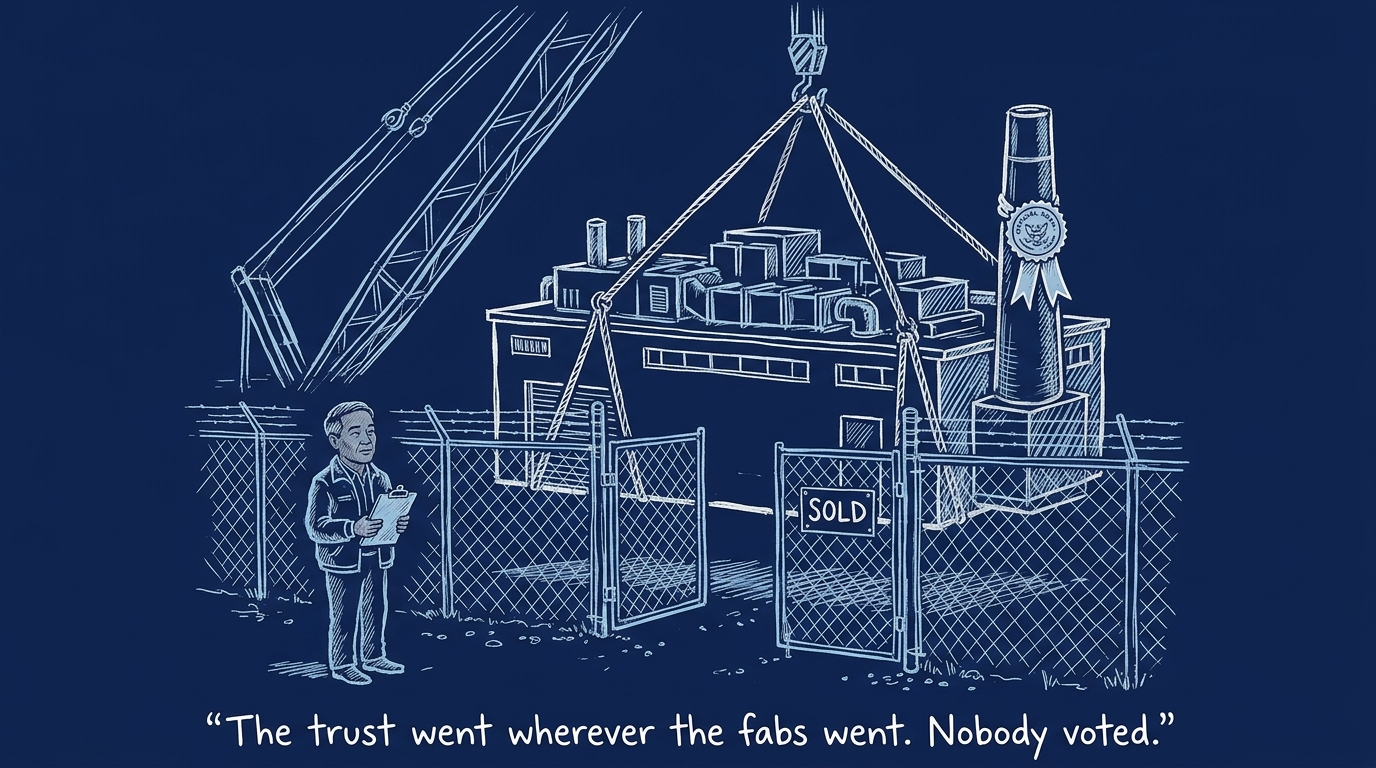
For a chip that ends up inside a national-security system, "trust" is not a metaphor -- it's a formal government certification, held by a small, specific list of factories, and the list changed hands in a single corporate transaction a decade before anyone was talking about chip supply chains in the news. The Department of Defense doesn't buy microelectronics for its most sensitive systems on the open market. It relies on the Trusted Foundry program, run by the Defense Microelectronics Activity, which certifies the specific people and processes -- not just the design -- behind national-security-sensitive chips.[1]
The certification started with two IBM fabs, and IBM sold them
The first-ever Trusted Foundry in the country was IBM's Fab 9 in Essex Junction, Vermont; Fab 10 in East Fishkill, New York followed soon after.[1] On July 1, 2015, IBM sold its entire microelectronics business -- both fabs, the manufacturing assets, the operations -- to GlobalFoundries in one transaction. The Defense Microelectronics Activity simply transferred the Trusted Foundry contract along with the sale, and GlobalFoundries' Vermont and New York fabs kept the same Category 1A and ITAR designation IBM's had carried.[1] The government's most sensitive electronics supply chain didn't change hands because of a policy decision -- it changed hands because IBM decided to exit chip manufacturing, and the trusted relationship went wherever the fabs went. GlobalFoundries has since formalized that role directly: a $3.1 billion, 10-year "Trusted Supplier" contract with the DoD, later expanded by another $400 million.[2]
2015IBM sells its trusted-fab business to GlobalFoundries in one transaction
80%+Share of leading-edge chip manufacturing capacity concentrated in Asia
$15.5BCombined CHIPS Act awards to Intel, Micron, and GlobalFoundries
Then the DoD needed a newer trusted source, because the leading edge had moved overseas
The GlobalFoundries fabs were real, but not on the industry's most advanced process nodes -- and more than 80 percent of leading-edge semiconductor manufacturing capacity is concentrated in Asia, leaving the Pentagon with limited onshore access to cutting-edge foundry technology for the chips its newest systems actually need.[3] That gap is what launched RAMP-C -- Rapid Assured Microelectronics Prototypes, Commercial -- in September 2021, a DoD program that selected Intel Foundry Services to establish and demonstrate a domestic, leading-edge chip ecosystem, working with IBM, Cadence, and Synopsys on what would become Intel's 18A process.[4] The Pentagon later selected Intel Foundry for a further phase of the same program, adding more defense-industrial-base customers, before the initiative completed and shifted focus to a follow-on "Secure Enclave" effort.[4]
The CHIPS Act put real money behind the whole structure
The 2022 CHIPS and Science Act's actual grants, finalized in late 2024, landed directly on the companies now carrying this burden: Intel received $7.865 billion, Micron up to $6.165 billion (plus $275 million specifically for its Manassas, Virginia facility), and GlobalFoundries $1.5 billion for its New York and Vermont expansion.[5] Micron's own reshoring story -- from a Boise dental-office basement in 1978 to the only major American memory chipmaker, now building a new fab meant to help close the gap from 37% of world semiconductor supply in 1990 to roughly 12% today -- is already told in full elsewhere on this site. What's specific to the trusted-microelectronics side of this story is narrower: the government isn't just trying to make more chips in America generally. It's trying to make sure a specific, certified, auditable set of factories can build the ones its own defense and intelligence systems actually depend on.
"Trust" can require fracturing a company's own board
GlobalFoundries itself is the sharpest example of what "trust" actually costs a company structurally. It is roughly 82 percent owned by Mubadala, Abu Dhabi's sovereign wealth fund -- a foreign government's own investment arm holds majority ownership of the single most trusted chip-fabrication relationship in the US defense supply chain.[6] That's only legally possible because of a specific federal mechanism: Foreign Ownership, Control, or Influence (FOCI) mitigation, governed by 32 CFR 117.11. A foreign-owned contractor handling classified or ITAR-controlled work has to wall that ownership off from the sensitive business, using measures that run from a simple board resolution up to the most restrictive options -- a Voting Trust or Proxy Agreement, where the foreign owner's voting rights pass to US-citizen trustees approved by the government, overseen by a Government Security Committee of cleared US citizens sitting inside the company's own board structure, separate from ordinary corporate governance.[7] The mechanism is not hypothetical or unusual: Fiberite Holdings' 1996 Security Agreement with the DoD required its board be split into Outside Directors with no prior relationship to the company, Inside Directors, and a security-cleared Officer Director -- a real, documented instance of exactly this structural split, and the same basic template still governs foreign-owned defense contractors today.[8]
The identical boundary runs through university research, though the rule is more contested than most people assume. National Security Decision Directive 189, the governing 1985 policy, states plainly that federal agencies must not place nationality-based restrictions -- "NOFORN" conditions -- on fundamental research: work that's freely publishable and open to the broader scientific community.[9] The restriction only attaches when research isn't fundamental in the first place -- when it's ITAR-controlled from the outset, or a sponsor has already imposed publication or access limits on it -- which disqualifies it from that protection and allows exactly the "no foreign nationals in the lab" condition sometimes attached to defense-sponsored university work. The rule was written to keep that the exception, not the default -- but it's real, and it runs on the same underlying logic as a fractured corporate board: control who can touch the sensitive part of the work, not the institution as a whole.
Why does this matter? "Trust," in this context, isn't a feeling about a supply chain -- it's a designation held by a short, specific list of named facilities, and that list has already changed hands once, in a transaction driven by one company's ordinary business decision to exit a market rather than by any deliberate national-security choice. The CHIPS Act and RAMP-C are the government's attempt to make sure that dependency never again rests on so few points of failure, or on whether a single company decides chip manufacturing is still worth its time. Tens of billions of dollars are now the price of not finding that out the hard way twice.
Everything above is about trust at the point of fabrication -- before a chip ever exists. A separate, parallel discipline asks the same question after the device is built and running: does it leak what it's processing to anyone close enough to listen. And a third asks it at the scale of an entire facility: what does its aggregate power draw reveal from a single point outside the walls. None of the three substitutes for the other two.
 Oluwadi