Shockoe Bottom sits in downtown Richmond, an eight-block valley running down to the James River. Between 1830 and 1865, an estimated 350,000 people were sold into slavery there -- the second-busiest slave market in the United States, behind only New Orleans. From 1830 to 1860, the domestic slave trade made up roughly half of Richmond's entire city economy.[1]
The lever: one woman, one bank, one neighborhood over
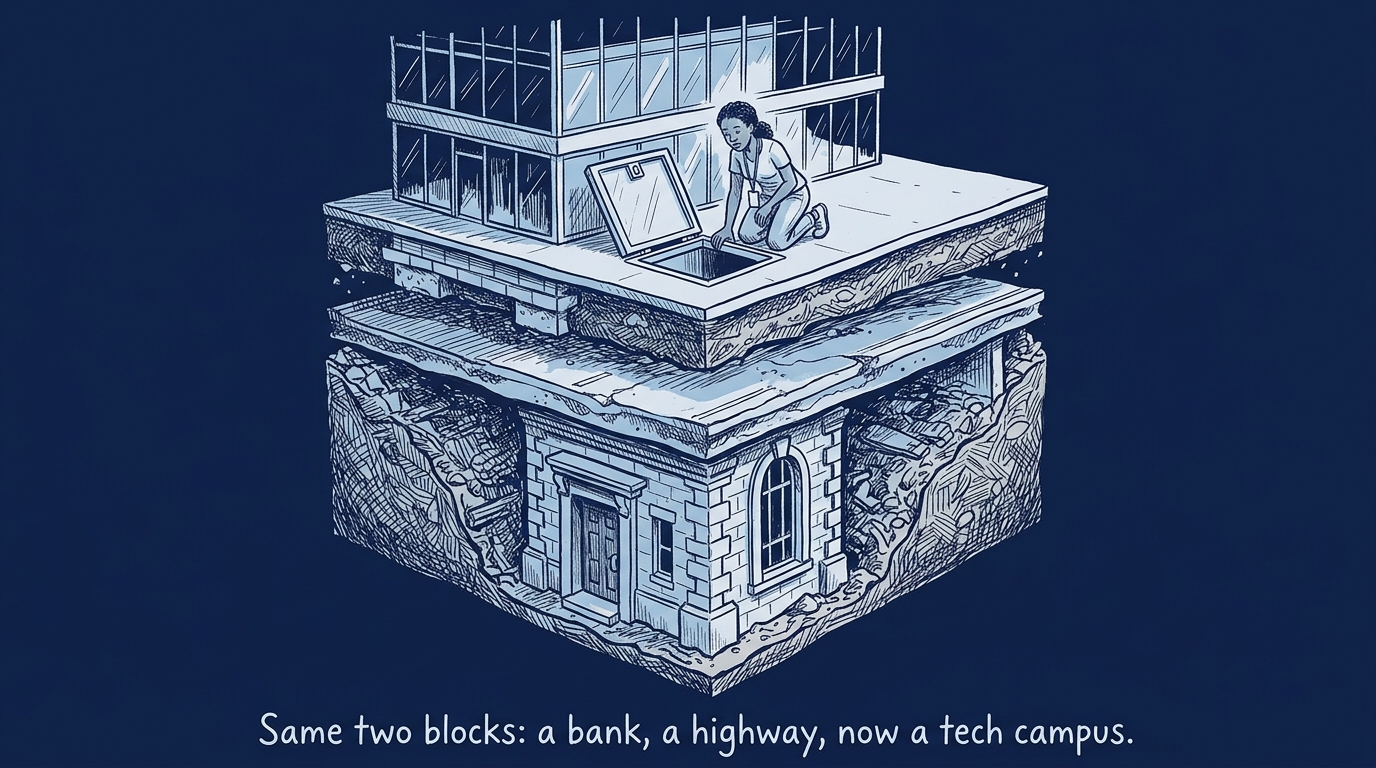
Jackson Ward sits immediately north of Shockoe Bottom, separated only by Broad Street -- less than a mile from the Virginia State Capitol. In 1903, Maggie Lena Walker chartered the St. Luke Penny Savings Bank there, becoming the first woman of any race in American history to charter and lead a bank -- and she did it as a Black woman starting a bank from scratch in the Jim Crow South. She ran it for nearly three decades, growing its assets more than tenfold before it became the Consolidated Bank and Trust Company in 1930, with Walker as chairman.[2]
Walker's bank was not an isolated success. Jackson Ward became known nationally as "the Harlem of the South" and "Black Wall Street" -- by 1920, an overwhelming majority of Black Richmonders lived there, supporting a self-sufficient Black middle and upper class built specifically around the credit, insurance, and loans that Jim Crow denied Black residents everywhere else in the city. Five separate Black-owned banks operated in the district between 1888 and 1930, not just Walker's.[3]
That professional class did not appear from nowhere. In 1883, Hartshorn Memorial College opened inside Jackson Ward itself, in the basement of Ebenezer Baptist Church, with an inaugural class of 58 women -- Walker herself later served as a trustee. Hartshorn spent nearly fifty years producing graduates who went on to teach, preach, and run businesses across the neighborhood, before merging in 1932 into Virginia Union University, founded in 1865 specifically to educate the newly emancipated. VUU's own alumni later included L. Douglas Wilder, the first elected Black governor in American history, and Admiral Samuel Gravely Jr., the first Black admiral in the US Navy. The bankers were not self-taught individuals succeeding in isolation -- the neighborhood built its own pipeline for producing them.[7]
The decision, made twice more, forty years apart
What happened to Jackson Ward afterward was not decline. It was decided, twice, by name.
In 1937, the federal Home Owners' Loan Corporation graded Jackson Ward's residential blocks "Fourth Grade" -- the lowest tier on its four-color risk map, marked in red. The designation made it nearly impossible for the neighborhood's residents to get a mortgage or a loan from that point forward, cutting off the exact kind of capital access Walker's bank had spent three decades building. The word for this practice, "redlining," comes directly from the color HOLC used on that map.[4]
Two decades later, the Richmond-Petersburg Turnpike -- built under the direct influence of highway planner Robert Moses and now part of I-95/I-64 -- was routed straight through the middle of Jackson Ward. Construction between 1954 and 1958 razed roughly 1,000 homes and businesses and displaced an estimated 7,000 residents, physically splitting the neighborhood into two halves that remain separated by the interstate today.[5]
1903Walker charters St. Luke Penny Savings Bank
1937HOLC grades Jackson Ward "Fourth Grade" (red)
1,000Homes/businesses razed for I-95, 1954-58
~7,000Residents displaced by the highway
The pipeline, running today under a different name
Richmond still runs an institutional pipeline for producing professionals and founders -- it has just moved a few blocks and changed its subject. Virginia Commonwealth University's Bio+Tech Park, downtown, hosts VCU TechTransfer and Ventures, which has helped launch more than 90 startups since 2016, alongside Activation Capital, which provides lab space, mentoring, and investor connections to the life-sciences companies that spin out of VCU's own research. Blue Heron Capital, a Richmond-based growth-equity firm founded in 2006, has made more than 40 investments in healthcare and enterprise technology companies, several of them homegrown: AnswersNow (digital autism therapy), Remission Medical (virtual rheumatology), Flourish Health (psychiatric care for children and young adults), and Cookie Finance (accounting for independent creators) all operate out of Richmond today.[8]
1865Virginia Union University founded
90+VCU-linked startups launched since 2016
40+Blue Heron Capital investments since 2006
4Blue Heron healthtech cos. HQ'd in Richmond today
The open door, not yet walked through
In 2023, Richmond was awarded $1.35 million in federal funding through the U.S. Department of Transportation's Reconnecting Communities Pilot Program to study reconnecting Jackson Ward's two halves -- one option under consideration is a "freeway lid," a structure built directly over the highway trench robust enough to carry parks and public space above it. The city aims to complete a feasibility study by the end of 2025, after which the city council would still have to vote on whether to move forward at all.[6]
 Oluwadi