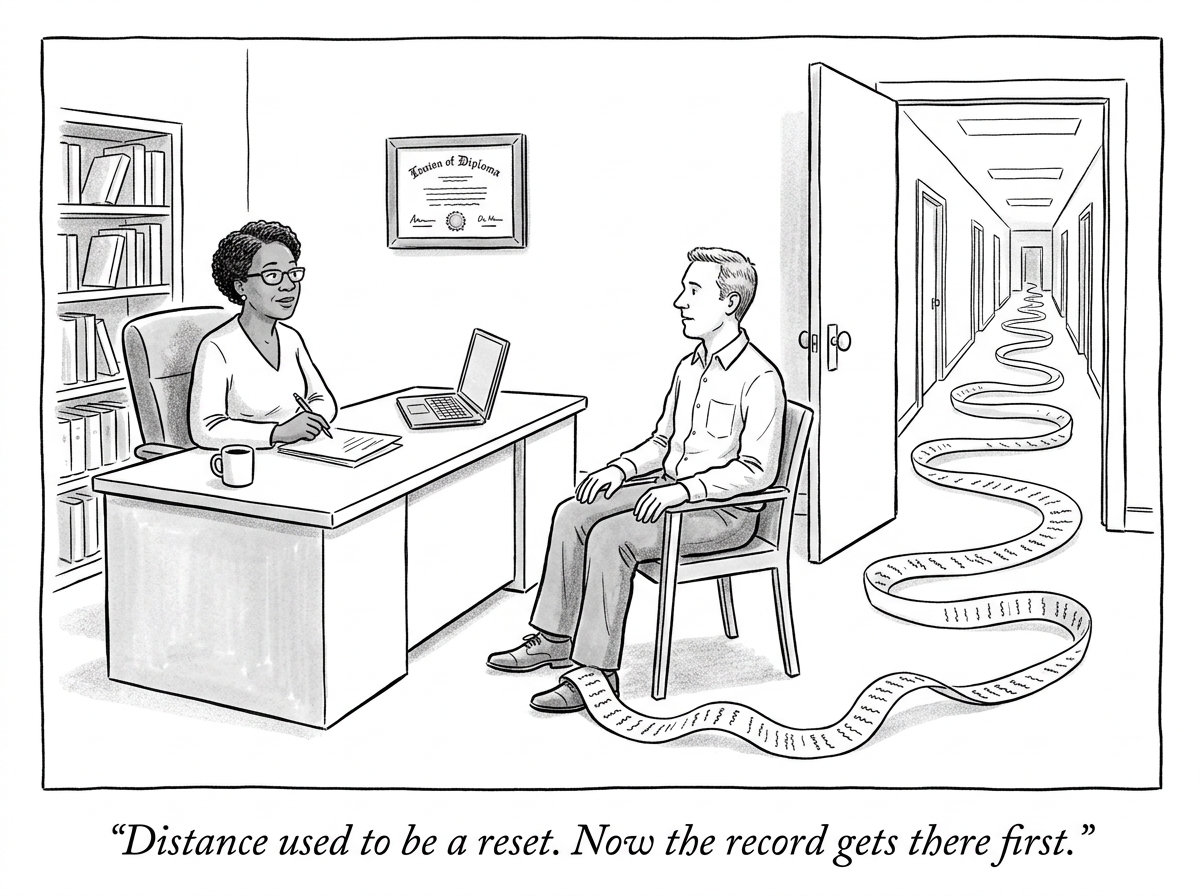
Before 1967, a criminal record in New Jersey genuinely might never reach California -- not because anyone hid it, but because no infrastructure existed to check. The FBI's National Crime Information Center went live on January 27, 1967, with 356,784 records across five files; by 1971 every state and DC was connected.[1] Consumer credit followed the same arc: local bureaus consolidated once computerization made data-sharing cheap, and the Fair Credit Reporting Act of 1970 was Congress catching up to an industry that had already gone national.[2] Distance used to be a real reset. Once the record could travel faster than a person could drive, it stopped being one.
The record follows you now, and someone is actually checking
93-96% of US employers run background checks today.[3] And even where the law provides an exit -- expungement (having the record destroyed) or sealing (hiding it from public view without destroying it) -- most people never actually get it: Colleen Chien's Second Chance Gap research finds 20-30 million Americans hold clearable non-conviction records that were never cleared, with some states' gap between eligible and delivered relief running 95-99%.[4] Worse, legal erasure often doesn't even work against data brokers, who scrape once and rarely update -- reporting on what's been called "zombie data" found sealed and expunged records still turning up in background checks years later, with only a handful of states -- Pennsylvania is the clean exception -- contractually forcing brokers to accept correction feeds.[5]
Is there a justice argument for full restoration? Yes -- and it's already law elsewhere
Retributive theory -- the idea that a punishment's whole job is to make someone pay their debt to society, no more and no less -- says the sentence is the debt; once served, nothing further is owed. That's not an abstraction -- the UK's Rehabilitation of Offenders Act 1974 implements it directly: after a defined rehabilitation period, a conviction becomes "spent," and by statute the person "shall be treated for all purposes in law as a person who has not been convicted of the offence."[6]
American law took the opposite path, deliberately. In Smith v. Doe (2003), the Supreme Court upheld sex offender registries by ruling they're civil and regulatory, not punitive -- meaning the law doesn't count them as punishment at all, just a rule, the same category as a licensing requirement. That single ruling became the load-bearing precedent (the case every later court has to follow) behind the whole regime of what lawyers call collateral consequences -- everything that keeps restricting someone's life after their sentence is technically over, from what jobs they can hold to whether they can vote. If a consequence is legally "not punishment," the debt-is-paid argument has no constitutional footing against it. The ABA's own National Inventory counts roughly 45,000 separate collateral consequences across state and federal law, most with no expiration date at all.[7]
Florida shows exactly how far that gap can be walked, even when voters explicitly vote to close it. In November 2018, 65% of Florida voters passed Amendment 4, automatically restoring voting rights on completion of sentence. Senate Bill 7066, signed June 28, 2019, redefined "completion of sentence" to require paying every fine, fee, cost, and dollar of restitution first -- and in September 2020 the 11th Circuit Court of Appeals upheld it en banc -- meaning the court's full roster of judges heard the case together and ruled, rather than the usual three-judge panel, a step reserved for questions the court treats as too important to leave to a smaller panel.[8] The result: the Sentencing Project counts more than 960,000 Floridians still disenfranchised. Of those nominally re-enfranchised, only about 31,400 -- under 8% -- have actually registered, and the state's own eligibility-tracking system was still unfinished years later; a form introduced after a 2024 settlement, letting someone simply ask the state whether they can vote, was used by only about 400 people in its first year.[9]
65%Florida voters who approved full restoration on completion of sentence, 2018
960,000+Floridians the Sentencing Project counts as still disenfranchised today
<8%Share of nominally re-enfranchised Floridians who have actually registered to vote
One subculture built an exemption, on purpose
Silicon Valley's venture-capital economy runs on the opposite norm: a founder's public failure is read as signal, not disqualification. Peer-reviewed research on serial entrepreneurs confirms this is real and regionally specific -- a documented contrast with Europe and Canada, not a myth Americans tell about themselves.[10] It isn't costless: previously-failed founders raise venture money at meaningfully lower rates than previously-successful ones. But "lower odds" and "permanently disqualified" are different categories, and almost nowhere else in the American economy gets to live in the first one.
The gap between Elizabeth Holmes and Adam Neumann isn't simply that he's richer. It's jurisdictional. Neumann's failure -- WeWork's collapse, his own ouster -- stayed inside the one system built to metabolize founder failure as information; Andreessen Horowitz funded him again in 2022 and 2025, the second time after WeWork's actual bankruptcy. Holmes's failure crossed into the criminal-justice system -- the same permanent, networked, actively-checked record described above -- and no amount of Silicon Valley's internal forgiveness culture has jurisdiction there. Same era, same industry, two completely different regimes governing whether a public failure closes the door.
1967NCIC goes live -- the first national, networked criminal-record system
95-99%Washington State's gap between eligible-for and actually-granted record relief
18% vs. 52%VC funding rate for previously-failed vs. previously-successful founders -- lower, not zero
What grace actually means here -- not sentiment, a checkable design choice
Bryan Stevenson built the Equal Justice Initiative on the opposite premise from everything documented above, and named it in one sentence in Just Mercy: "Each of us is more than the worst thing we've ever done."[11] Every mechanism in this piece -- the 1967 database, Smith v. Doe's civil-not-punitive doctrine, Florida's 8% -- is the machinery of the opposite belief, that a person is the worst thing they've done, permanently and by law. Grace, in this frame, isn't a feeling. It's the specific, checkable question of whether a system is built to let the record stop defining someone once the debt is paid. The UK decided that by statute. Silicon Valley decided it informally, for its own. Everyone else is still waiting on an answer nobody has to give -- which is the whole of what this piece has been documenting: not that reinvention became harder, but that three separate, deliberate decisions -- a database, a doctrine, an industry's private culture -- closed off who gets to ask the question at all.
Companion piece on this outlet: "A Camera Hidden Inside a Fake Construction Barrel Flags Your Car as 'Suspicious'..." -- the same erosion of distance-as-reset, minus the requirement that you've done anything at all.
 Oluwadi