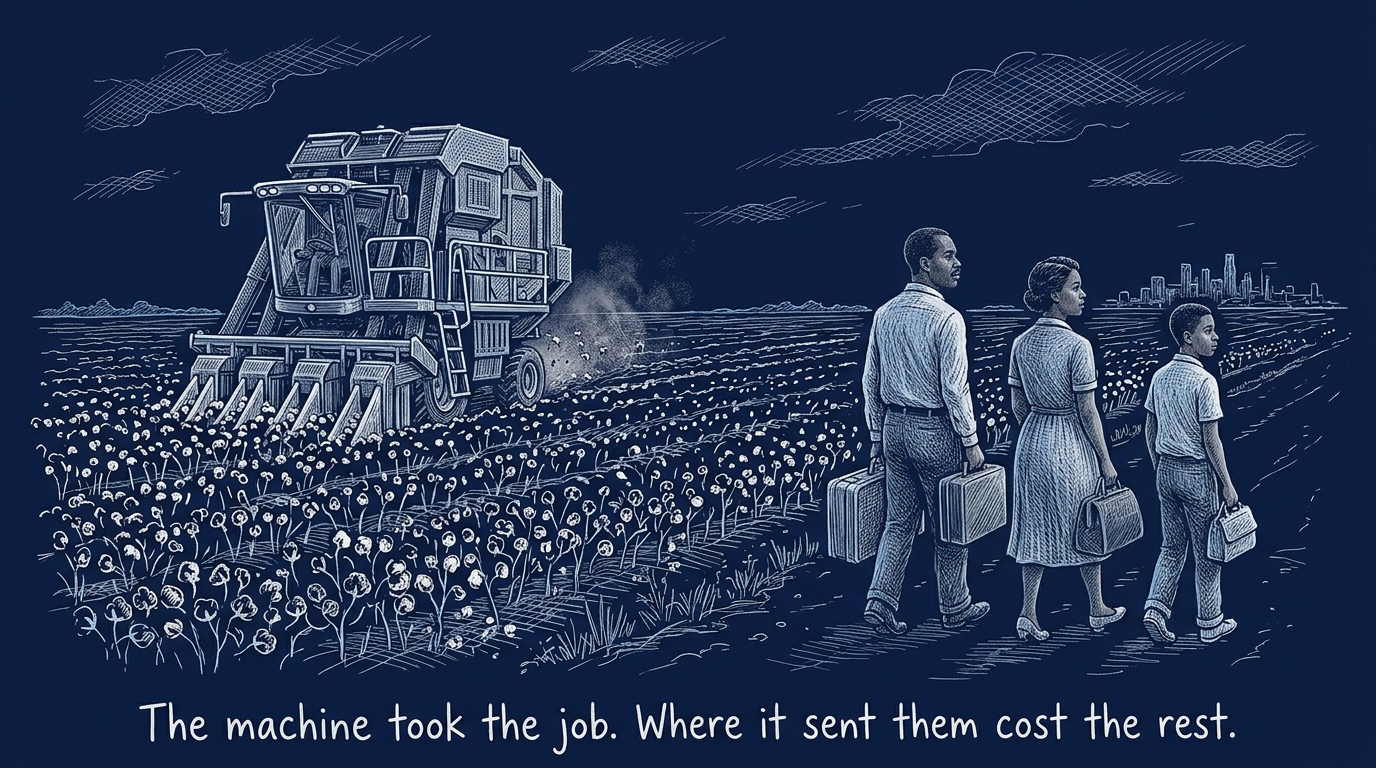
Between 1910 and 1970, roughly six million Black Americans left the rural South for cities in the North, Midwest, and West -- one of the largest internal migrations in U.S. history.[1] The second, larger wave of that migration, after World War II, tracks closely with a specific technological event: the mechanical cotton picker, which spread across the Cotton South between the late 1940s and mid-1960s and made the sharecropping system that had organized rural Southern labor since the Civil War economically obsolete.[2] It is the closest thing available to a worker-level natural experiment in what actually happens when a machine makes a large share of a country's labor force unnecessary at once -- and the rigorous, decades-later answer isn't the one the aggregate numbers alone would suggest.
6MBlack Americans who left the rural South, 1910–1970, in the wave of migration mechanization helped drive
27%of today's Black-White upward-mobility gap a 2022 study traces directly to how Northern destinations reacted to that migration -- not to the move itself
19%how far below expected employment young workers in AI-exposed jobs now sit, per real 2026 payroll data -- the first live version of the same question
What actually caused the exodus off Southern farms is more contested among economic historians than the popular version of the story suggests, and worth representing honestly rather than flattening into a clean cause-and-effect. The traditional account treats the mechanical cotton picker as the engine that pushed sharecroppers off the land. A more recent, institutionally-focused account -- most fully developed in historian Donald Holley's study of the mechanization era -- argues the sequence often ran the other way in a given county: wartime industrial jobs and worsening conditions were already pulling and pushing labor off the land first, and mechanization followed as landowners' response to a labor force that was already leaving, not the initial trigger.[2] Both accounts agree on the outcome: by the mid-1960s, hand-picked cotton was essentially gone from the Delta, and the sharecropping system that had employed a huge share of the rural Black South was gone with it. The disagreement is about which came first, not about whether millions of people's livelihoods disappeared.
The number that actually matters for a country running this experiment again is what happened next -- and that's where a 2022 study, using Great Migration data as a natural experiment, produced a finding sharper than "people moved and mostly did fine." Economist Ellora Derenoncourt found that the racial makeup shift large-scale Black in-migration caused in Northern cities changed how those cities responded -- through increased policing, more residential segregation, and other institutional reactions to the arrival of large new Black populations -- and that this response, not any difference in who chose to move, measurably reduced the economic gains migrants and their descendants captured from relocating. Her estimate: that dynamic explains roughly 27 percent of the Black-White gap in upward mobility that still exists in America today.[3] The people who left the cotton fields largely did what displaced workers are always told to do -- they moved toward opportunity, into growing industrial cities, in enormous numbers. The mechanism that capped how much they gained from doing it wasn't inside their own choices. It was on the receiving end, in how the places they landed in decided to treat them.
Detroit shows that mechanism operating at the level of a single employer, not just a city. By 1920, only five of Detroit's 67 auto plants hired Black workers at all -- but Ford Motor Company was the outlier, its Black workforce growing from roughly 200 in 1917 to more than 5,300 by 1922, and it became the largest single employer of Black workers in the country through the 1920s and 1930s.[4] That hiring rode on the same wage Ford had first offered in 1914 to fix a crisis of its own making: assembly-line work was so punishing that annual turnover hit 380 percent, and Highland Park recorded more than 200 severed fingers and 75,000 burns, cuts, and puncture wounds in a single year before the $5 day made the job tolerable enough to keep workers on it.[5] Even inside the one company willing to hire at scale, the sorting continued: Black workers were disproportionately placed in the River Rouge Complex's foundry and blast furnace, the most dangerous jobs in the plant, with a de facto ceiling on promotion into skilled trades or management that White workers didn't face.[4] One company, hiring at a scale its competitors refused, still reproduced the same sorting the city was doing at large -- proof that Derenoncourt's finding operates below the level of a metro area too: not just which city took you in, but which specific jobs inside it you were allowed to hold.
The live version of this question is already producing its first real data, and so far it has the same shape: not broad collapse, but a sharp, measurable effect concentrated in the group with the least power to absorb it. A 2026 Stanford Digital Economy Lab study, using actual ADP payroll records covering millions of U.S. workers, found employment for young workers (22-25) in occupations most exposed to generative AI now sits 19 percent below where it would be had it tracked their less-exposed peers -- a gap that has widened, not stabilized, through 2026. The same study found no comparable effect for experienced workers and explicitly reported no evidence of broad, economy-wide job displacement yet.[6] A separate analysis from the Yale Budget Lab, using different data through 2025, found no clear aggregate relationship yet between AI exposure and unemployment nationally, and cautioned that early-stage effects of a new general-purpose technology are historically hard to detect before they compound.[7] Both things can be true: the aggregate economy hasn't cracked, and the youngest, most exposed slice of the workforce is already, measurably, losing ground.
The two most-discussed policy answers to this are far less settled than advocates on either side suggest, and the real pilot data is more mixed than either side's framing implies. The largest and most rigorous test of unconditional cash to date -- a three-year, $1,000-a-month study of 3,000 low-income Americans funded by OpenAI's Sam Altman and analyzed in a series of NBER papers -- found employment among recipients fell by about 2 percentage points relative to the control group, with recipients working roughly 1.3 to 1.4 fewer hours a week, cutting against the standard pro-UBI narrative.[8] But Oakland's own guaranteed-income pilot, which ran from January 2022 to mid-2023 before the city discontinued it, found employment moving the opposite direction: full-time work rose from 15 percent to 26 percent in the $500-a-month treatment group, against a rise from just 14 to 18 percent in the control group -- the opposite of the disincentive effect critics predicted, confirmed by the study's own independent university researchers.[9] What Oakland's researchers found more telling than either employment number, though, was what happened to housing. While payments were flowing, treatment-group families had 38 to 44 percent lower odds of homelessness than the control group. Six months after the payments stopped, that entire advantage had vanished -- both groups converged to the same rate. The study's own authors modeled what doubling the payment to $1,000 a month would have done, and concluded it still would not have been enough to overcome Oakland's underlying cost of living; lasting change, they concluded, requires broader policy change running alongside cash, not cash by itself.[9] That is the same pattern the Great Migration data already showed, at a much smaller scale and in real time: relief works while it's flowing and evaporates the moment it stops, because the surrounding structure -- rents, wages, the job market -- never changed underneath it. The other leading proposal, a tax on automation to fund worker transitions, has an even thinner real-world record: economist Robert Shiller's original 2017 case for a temporary, transition-smoothing robot tax has never been implemented anywhere in the form he proposed, and the policy sometimes cited as the first real-world robot tax -- South Korea's 2017 change -- was actually a reduction in an existing tax subsidy for automation investment, not a new cost imposed on it.[10] Neither proposed fix has been tested anywhere near the scale a real AI-driven labor shift would require.
The strongest case against treating any of this as inevitable mass unemployment is also real and shouldn't be waved away. Automation has historically displaced specific tasks and hollowed out the middle of the wage distribution far more than it has reduced the total number of jobs in the economy -- the standard finding, developed most fully by economist David Autor, is that new technology creates complementary work even as it destroys old roles, which is why net employment kept growing through every prior wave of automation.[11] But that same body of work contains the harder-edged counterpoint, and it isn't only that recovery is slow -- it's that a meaningful share of displaced workers never make the jump into something new at all. Studying Chinese import competition's effect on American manufacturing communities between 1990 and 2007, Autor, David Dorn, and Gordon Hanson found the offsetting job gains economic theory predicts "have yet to materialize" in the hardest-hit regions even a decade later, wages and labor-force participation still measurably depressed -- and found enrollment in federal disability insurance rose sharply in exactly those communities, a paper trail of workers who didn't retrain or relocate into new work, but left the labor force entirely.[12][13] South Bend, Indiana is the older, starker version of the same failure to retrain: when Studebaker closed its last South Bend assembly line on December 20, 1963, eliminating roughly 7,500 remaining jobs in a company that had employed 24,000 people there at its peak, the city did not quietly retrain its way into a new economy. It lost 30 percent of its population and spent six full decades in decline before its old factory floor became a technology campus in 2016 -- a fifty-three-year gap between the jobs disappearing and anything resembling a transition completing.[14] The reassuring version of automation history is true in aggregate and over long enough time horizons. It has also, three times now in the data we actually have -- South Bend, the Rust Belt and Appalachian communities hit by Chinese import competition, and cotton counties two generations before either -- been cold comfort to the specific people who couldn't make the transition, not just the ones who made it and landed somewhere unwelcoming.
Newark's Central Ward -- Avon Avenue runs through the middle of it -- puts an outer bound on how long that recovery can take, and it complicates the class-not-race point in an important way. Starting around 1960, Route 280 was carved straight through Newark's Central and North Wards, followed by Route 78 through Weequahic around 1963, displacing at least 5,000 residents and closing hundreds of small businesses for the highways alone.[15] That was one piece of a much larger program: Newark ran 17 separate urban renewal projects between 1952 and 1967, making it the second most "urban renewed" city in the country after Norfolk, Virginia, and one of those projects alone -- a planned 200-acre medical school campus -- was set to displace 22,000 residents, mostly Black and Puerto Rican, from the city's single most densely populated Black neighborhood.[16] That is a different mechanism than Studebaker's collapse, but not a different kind of test. A struggling company's balance sheet eliminates whichever workers are cheapest to let go; a highway route and a redevelopment map get drawn through whichever neighborhoods have the least political power to stop them. Both are class tests, not racial ones -- but by 1960, decades of redlining and segregation had already sorted Newark's Black residents into exactly the neighborhoods with the least power to fight a highway route, which is why a test built around power reads, in its result, as a test built around race. The four days of uprising that followed in July 1967 arrived on top of that disinvestment, not as its cause. Newark's population then kept falling for another quarter-century -- losing more than 160,000 residents between 1950 and 1990, a full third of that loss in the 1980s alone -- and didn't stabilize until the 1990s, more than thirty years after Route 280 went in.[17] Recent local reporting still describes the Central Ward specifically as lacking the economic and social renewal downtown Newark has started to see.[18] Run the clock from the highway construction to today and Newark's hardest-hit ward is more than sixty years into a recovery that outside reporting still won't call finished -- longer than South Bend, longer than the China-shock regions, because the powerlessness test that produced it landed on a population segregation had already concentrated in one place, with nowhere else in the city for the loss to spread out and thin.
The country's instinct is to read all of this along racial lines -- the Great Migration as a Black story, the Rust Belt collapse as a White one -- and the honest picture is more precise than either. South Bend is the case that argues against that instinct: Black residents were roughly 3 percent of its population in 1940, a share that grew through the 1950s and '60s specifically because factory jobs at Studebaker and its neighbors offered the same escape from Southern sharecropping driving the Great Migration everywhere else in this piece -- South Bend was a real, if smaller, Great Migration destination, not a separate story from Detroit's.[19] When Studebaker collapsed in 1963, it hit the whole workforce it had built, longtime residents and recent Black migrants alike, as one economic class, because a company's own bankruptcy doesn't sort by race. Sociologist William Julius Wilson built a career-spanning argument out of that exact distinction, most fully in his 1996 study of deindustrialized Chicago: that the loss of blue-collar jobs to a changing economy, more than racism as such, was the structural engine behind the modern urban underclass -- a mechanism that hits Black and White communities alike, at different moments, for the same underlying reason.[20] Newark is the case that keeps that claim from overreaching in a different way: some of the twentieth century's worst economic displacement wasn't blind to class at all -- it ran on a direct test of who had the political power to say no to a highway route, and segregation had already made sure Black neighborhoods failed that test more often than anyone else's. What both cases share, and what Derenoncourt's data and Ford's own hiring records confirm from the other direction, is the second mechanism layered on top of either kind of loss: once a place or a person is knocked down, race shapes how much of any recovery they're allowed to keep, and how long that recovery is allowed to take. A country trying to get ready for what AI does next needs all three pieces -- who loses the job, whether the test that decided it ran on wages or on raw political power, and who gets to recover -- not just one.
The country has already run a real, large-scale version of "what happens when a machine makes millions of jobs disappear," and the answer that survived scrutiny decades later wasn't about the machine. It's a shift in the economy, not one company's decision or one technology's fault -- and most of the time, whose job disappears sorts by class, not race: by who holds the kind of replaceable, wage-defined work a machine or a balance sheet can eliminate in a single decision, the way Studebaker's collapse hit South Bend's longtime residents and its newer Black migrants alike. That isn't the whole picture, though -- Newark's Central Ward shows the exception that matters: when the displacement is a policy decision, a highway route, a redevelopment map, the test is political power, not wages -- and where segregation has already concentrated a race on the powerless side of that test, the result reads as racial even when the test itself wasn't built that way. Recovery from that kind of loss runs on a different, longer clock. Either way, what happens after is shaped further still: Ford hired Black workers into Detroit at a scale its competitors refused, and still funneled them into the plant's most dangerous jobs; Northern cities absorbed six million Great Migration workers and still capped how much they gained from moving. Right now, the clearest AI-era data available says the newest version of this story is starting the same way: not a broad collapse, but real, measurable harm concentrated in the workers with the least power to absorb it, arriving faster than either of the leading proposed fixes has ever been tested. The open question isn't whether displaced workers, in aggregate, will try to adapt. History already answered that most will try, regardless of race. It's what happens to the ones who can't, whether the test that hit them ran on wages or on power, and whether the places and systems around all of them let the ones who do keep what they earn from it -- and on all three counts, the record isn't reassuring.
 Oluwadi