The Standard Oil Company of Louisiana was chartered on April 13, 1909, as a subsidiary of Standard Oil of New Jersey. Construction began immediately on a tract of former cotton-plantation land along the Mississippi River, chosen for deep-draft tanker access and proximity to Louisiana's newly discovered oil fields. Within a year the refinery employed roughly 700 workers processing 1,800 barrels of crude a day. It transformed Baton Rouge, in one contemporary account, "almost overnight into a high-tech center."[1]
The plant never stopped growing. Today it is the sixth-largest oil refinery in the United States and the seventeenth-largest in the world, processing 540,000 barrels of crude a day across roughly 2,100 acres, and it has now operated continuously for more than 115 years.[1]
The neighborhood the refinery built, then unbuilt
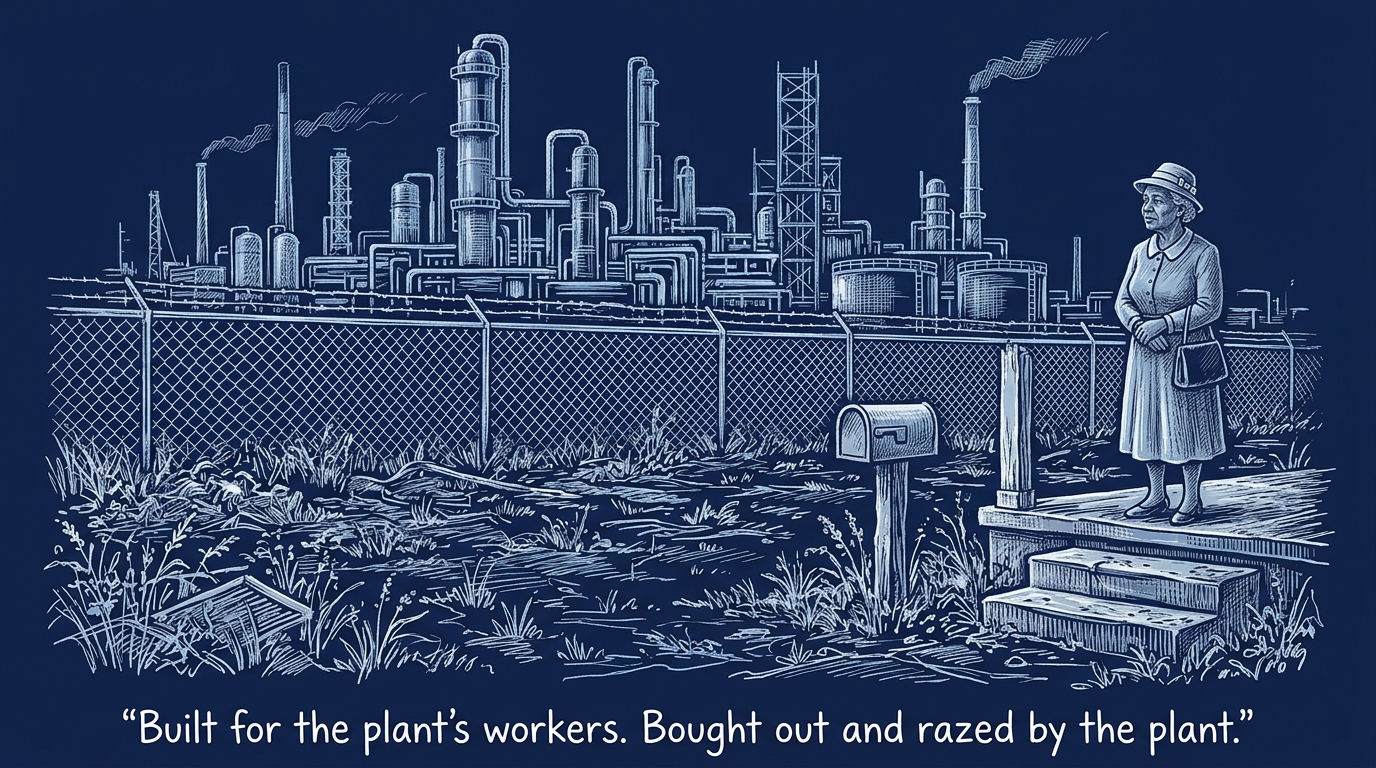
Standard Heights, immediately south of the plant, was originally home to many of the refinery's own workers. Over the following decades it became a majority-Black neighborhood in north Baton Rouge, its residents living directly against the refinery's fence line. In 2013, a group of Standard Heights residents sued, alleging that emissions from the plant had damaged their property and caused sickness and emotional distress.[2]
ExxonMobil's response was not to reduce the plant's footprint. It was to buy the neighborhood. Most of Standard Heights has since been purchased, its former residents relocated, and its homes razed -- an outcome one long-form account of the buyout described from the perspective of residents including Denise Moore, offered around $18,000 for her property -- not enough, she said, to buy a comparable house anywhere else in the city -- and Rose Christopher, told Exxon's offer wasn't enough "to make a note on a new house." Moore, Christopher, and neighbor Brunetta Sims refused to sell and are still there today, living beside a refinery that has bought out nearly everyone else around them.[3]
1909Standard Oil chartered, refinery built
6thLargest US refinery today
540,000Barrels of crude processed daily
115+Years of continuous operation
The industry is still expanding around what's left
The petrochemical build-out around Baton Rouge has not slowed. As of a 2023 regional economic report, the area had $11.6 billion in industrial projects already underway -- including Air Products' $4.5 billion hydrogen plant, Methanex's $1.6 billion methanol facility, and Shintech's $1.3 billion PVC expansion -- with another $19 billion in announced projects considered likely to reach final investment decisions, including a $7.5 billion ammonia plant and a $9.4 billion renewable fuel facility. Economists projected the region would add roughly 24,500 jobs by 2025 on the strength of this build-out, with immediate demand for 2,000 electricians and 2,200 pipefitters and welders alone.[4]
Louisiana State University has run an accredited petroleum engineering program for more than fifty years, training the workforce this industry depends on, with graduate research sponsored directly by companies including ExxonMobil, Chevron, Shell, and BP.[5]
$11.6BIndustrial projects underway, 2023
$19BAdditional projects announced
24,500Projected new jobs by 2025
50+Years of LSU petroleum engineering
 Oluwadi